
Table Of Contents
- Introduction
- Why Grade Control Matters On Modern Jobsites
- Common Grade Problems That Create Rework
- How The Grade Control Process Works
- Choosing The Right Setup For The Project
- Benefits For Crews And Project Teams
- Steps For Adding Grade Control To A Workflow
- Mistakes That Can Limit Accuracy
- How To Measure Results
- What To Watch As Grade Control Technology Evolves
- Conclusion
Grade control helps construction crews place material, excavate, shape surfaces, and prepare sites to the elevations and slopes shown in approved plans. Whether the work involves a building pad, utility trench, road section, drainage feature, or final grading, accurate results depend on a process that connects design information, site control, equipment setup, and field verification.
For contractors evaluating practical tools for that process, affordable excavator grade control can improve visibility into bucket position and target grade during excavation. Technology can support faster decisions in the cab, but it works best when crews also follow sound surveying, calibration, and quality-control practices.
Why Grade Control Matters On Modern Jobsites
Elevation, depth, cross slope, and surface consistency affect nearly every stage of earthwork. A small error can leave a trench too shallow, a pad too high, a drainage run without the required fall, or a finished surface that needs additional passes to correct. Those corrections can consume machine time, delay follow-on trades, and create avoidable material handling.
Grade control gives operators a clearer reference while work is underway. Instead of relying only on intermittent stakes or final checks, crews can compare the work in progress against a target and identify issues earlier. It does not replace an approved plan, reliable control points, or experienced operators. It helps those parts of the workflow work together.
Common Grade Problems That Create Rework
Many grade issues begin before the machine starts moving. Common causes include outdated design files, unclear benchmarks, poor calibration, and a lack of communication between the office, survey staff, foremen, and operators. Changing soil conditions can also affect how material cuts, fills, compacts, and drains.
Another frequent problem is waiting until the end of a task to inspect it. Final verification remains essential, but checking progress during production gives crews a chance to correct a small deviation before it becomes a larger repair. The goal is not to eliminate checks. It is to make checks timely and useful.
How The Grade Control Process Works
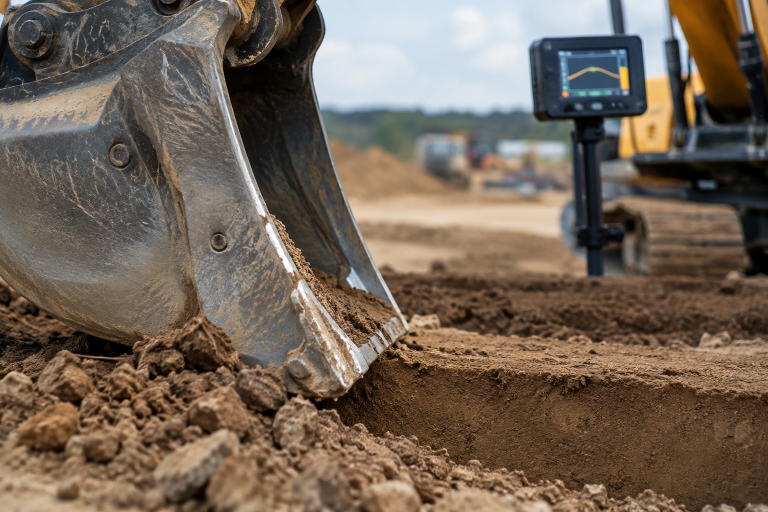
- Review the approved design, scope, tolerances, and sequence of work.
- Confirm benchmarks, control points, coordinates, and any required site calibration.
- Load the correct digital model or establish the required depth, slope, or elevation target.
- Verify the machine, attachment, sensors, and display setup before production begins.
- Work while monitoring real-time guidance and performing independent field checks.
- Compare completed work against the approved design and document any needed corrections.
- Update the workflow when design revisions or changes to field conditions affect the work.
Consider a utility trench. If the crew confirms the control point, target depth, and pipe slope before excavation, it can spot an incorrect setup near the start of the run rather than after the trench is complete. That early check may prevent excess excavation, added bedding material, or delays during pipe installation.
Choosing The Right Setup For The Project
Simple Guidance For Smaller Or Repeated Tasks
Basic depth, slope, and elevation guidance can suit repeatable excavation and grading tasks with straightforward requirements. A simpler setup may be easier to train on, easier to maintain, and appropriate when a detailed site model is not necessary for the work.
Advanced Guidance For Complex Site Models
Complex road profiles, changing surfaces, large civil sites, and work requiring detailed digital designs may call for more advanced machine-control workflows. An overview of common guidance approaches can help frame discussions about 2D, 3D, GNSS, and mastless technology. The right choice still depends on tolerances, equipment, site conditions, available support, and the crew’s ability to manage models correctly.
Benefits For Crews And Project Teams
Operators
Operators gain clearer targets while digging, shaping, and trimming. Better visibility into depth or slope can reduce uncertainty and limit interruptions for routine grade checks, while still leaving the operator responsible for safe, controlled machine operation.
Surveyors And Project Managers
Survey teams can focus more attention on site control, layout, verification, and complex conditions rather than repeatedly checking every production pass. Project managers can use a consistent workflow to improve communication, identify rework patterns, and maintain better quality-control records.
Steps For Adding Grade Control To A Workflow
- Start with a pilot task. Choose work with clear grade requirements and measurable outcomes.
- Set a baseline. Record rework hours, repeat checks, material movement, and inspection results.
- Assign ownership. Define who manages models, calibration, field checks, and operator support.
- Train the full team. Include operators, foremen, survey personnel, and managers.
- Test before production. Check a known point and confirm attachment measurements.
- Review results weekly. Correct process issues before they become routine.
Mistakes That Can Limit Accuracy
Common mistakes include using the wrong design-file version, skipping calibration after an attachment change, failing to verify a known point, and treating the display as a substitute for field verification. Weather, soil movement, revised plans, and damaged control points can all affect results. Good hardware cannot compensate for poor models or unclear procedures.
How To Measure Results
Evaluate the workflow with several measures rather than machine speed alone. Useful indicators include:
- Hours spent correcting completed work.
- Repeated or failed grade checks.
- Material moved more than once.
- Machine hours and fuel used per completed area.
- Time between excavation, verification, and approval.
- Design changes caused by preventable field errors.
- Safety observations tied to unnecessary machine movement or added site activity.
What To Watch As Grade Control Technology Evolves
Construction teams are continuing to connect design data, machine guidance, field verification, and office records more closely. Factory-ready systems, retrofit options, mixed-fleet support, remote assistance, and simpler operator interfaces can all influence adoption. The people using the tools remain central to the outcome, which is why the human side of grade control deserves as much attention as the equipment itself.
Common Questions
Is Grade Control Worth It For Small Contractors?
It depends on the frequency of grade-sensitive work, the cost of rework, the required tolerances, and available support. Starting with one machine or one repeatable task can make evaluation more manageable.
Does Grade Control Replace A Surveyor?
No. It supports production work, but professional surveying, site control, design review, and final verification remain essential parts of an accurate workflow.
Can Grade Control Work On Older Equipment?
Retrofit options may be available, but compatibility depends on the machine, hydraulic system, attachments, sensors, software, and local service support.
Conclusion
Better grade results come from a complete process, not a single piece of equipment. Clear plans, reliable control points, trained crews, accurate setup, regular verification, and useful field data can help construction teams reduce rework and keep sitework moving with greater confidence.

